Peptides vs. Retinol for Aging Skin — Which Do You Actually Need?
Few skincare debates generate more confusion than peptides vs. retinol. Dermatologists widely recommend both for aging skin. Both have genuine scientific support. And yet they work completely differently — which means the right choice depends not on which is ‘better’ in an abstract sense, but on your skin’s specific needs, your sensitivity level, and where you are in your skincare journey. In many cases, the answer is not one or the other — it’s both, used strategically.
This guide gives you a clear, honest comparison. We cover how each ingredient works at a biological level, the practical differences in how they perform and feel on the skin, who each is best suited for, and how to combine them effectively if you decide to do both. No hype in either direction — just what science says.
How Retinol Works — The Vitamin A Pathway
Retinol is a form of Vitamin A, and it belongs to a class of compounds called retinoids. When you apply retinol topically, your skin absorbs it and converts it — through a two-step enzymatic process — into retinoic acid, the biologically active form. Retinoic acid works by binding to nuclear receptors (RAR and RXR) inside skin cells, directly influencing gene expression. In practical terms, this means retinol can instruct skin cells to behave more like younger cells.
Extensive research documents the specific effects of retinoic acid on aging skin. It accelerates cell turnover in the epidermis, helping shed older, dull surface cells faster and reveal fresher skin beneath. Retinoic upregulates the genes responsible for collagen I and III synthesis in dermal fibroblasts. It downregulates matrix metalloproteinase (MMP) production, slowing collagen degradation. And it visibly reduces the appearance of fine lines, uneven pigmentation, and skin texture over consistent use.
Prescription-strength tretinoin (all-trans retinoic acid) is the most studied retinoid and produces the strongest results. Over-the-counter retinol is less potent — it requires conversion to retinoic acid before it becomes active — but is considerably more accessible and tolerable for most skin types.
📖 Science Note: The first clinical evidence for topical retinoids in treating photoaged skin was published by Kligman et al. in the Journal of the American Academy of Dermatology in 1986. Subsequent decades of research have confirmed retinoids as the most evidence-rich topical agents for visible collagen support and epidermal renewal, though their use requires an adaptation period and ongoing sun protection.
How Peptides Work — The Signal Pathway
As we covered in depth in our companion article [What Are Peptides for Skin? →], signal peptides work through a completely different mechanism. Rather than entering the cell nucleus and altering gene expression, they interact with surface receptors on fibroblasts, mimicking the naturally occurring peptide fragments that signal the skin to produce collagen. Think of retinol as reprogramming the skin’s operating system. Peptides, by contrast, are sending targeted text messages to specific cells — ‘produce more collagen here’ — through the skin’s existing communication channels.
The three signal peptides in the Natuderma Tripeptide Cream each target a distinct pathway. 1,-Palmitoyl Tripeptide-1 stimulates fibroblast collagen synthesis via GHK receptor binding. 2.- Palmitoyl Tetrapeptide-7 reduces the inflammatory IL-6 signaling that drives MMP-mediated collagen breakdown. 3.- Palmitoyl Tripeptide-5 activates the TGF-β signaling cascade — one of the primary biological switches controlling collagen gene expression. Together, they address collagen from three simultaneous angles.
📖 Science Note: The TGF-β (Transforming Growth Factor Beta) pathway is one of the most studied signaling cascades in dermal biology. It regulates fibroblast proliferation, collagen synthesis, and matrix remodeling. Palmitoyl Tripeptide-5 mimics thrombospondin-1, the endogenous activator of latent TGF-β, making it one of the most mechanistically specific signal peptides available in topical skincare.
The Key Differences — A Practical Comparison
Understanding the mechanisms above reveals why these two ingredients differ so significantly in how they feel to use and who they suit best.
Tolerance and Skin Sensitivity
This is perhaps the most practically significant difference. Retinol — even at low concentrations — causes an initial adaptation period for most users. The skin may experience dryness, flaking, redness, or temporary increased sensitivity during the first two to six weeks. This is expected and does not mean the product is wrong for you; it reflects the accelerated cell turnover the retinoid is driving. However, it does mean retinol requires a careful introduction — starting with low frequency (once or twice a week), building gradually, and always pairing with high-quality moisturizer and diligent sun protection.
Peptides, by contrast, are exceptionally well tolerated from day one. There is no adaptation phase, no purging period, no increased photosensitivity. Signal peptides are gentle enough for daily use morning and evening, on all skin types including sensitive and reactive skin. This makes them an excellent entry point for anyone new to active skincare, as well as a reliable daily foundation for those who also use retinol.
Speed and Visibility of Results
Retinol tends to produce more dramatic visible results over time — particularly for deep wrinkles, significant textural issues, and hyperpigmentation. Its direct gene-level activity produces measurable structural changes that accumulate over months and years of consistent use. Prescription tretinoin is even more potent in this regard. For significant photoaging, retinoids remain the most evidence-backed topical intervention available without a procedure.
Peptides work more progressively and subtly. Their effects on firmness, hydration, and fine line depth are real — and supported by published clinical data — but they are less dramatic than high-strength retinoids, particularly in the short term. What peptides offer is consistent, gentle, cumulative improvement without the side effects that lead many people to abandon retinol prematurely.
Sun Sensitivity
Retinol increases photosensitivity, making daily broad-spectrum SPF non-negotiable during retinol use. For this reason, retinol is typically applied only at night. Peptides do not increase sun sensitivity and can be used morning and evening without restriction — though daily SPF remains best practice regardless of your routine.
Pregnancy and Nursing
Medical professionals contraindicate retinoids during pregnancy and nursing— this is a firm, well-established precaution based on the teratogenic risk of systemic Vitamin A derivatives. Peptides carry no such restriction. For those who are pregnant, nursing, or planning to conceive, a peptide-based anti-aging formula is the appropriate choice while retinoids are paused.
Who Should Choose Peptides?
Peptides are the right primary choice — or an excellent starting point — in several scenarios:
- New to active skincare: If you are building your first results-driven anti-aging routine and want immediate tolerance without an adjustment period, peptides are the more approachable entry point.
- Sensitive or reactive skin: Skin that struggles with redness, barrier disruption, or reactivity to actives will generally tolerate peptides well, whereas retinol may provoke flares.
- Pregnant or nursing: Peptides carry no known contraindications in pregnancy, making them the anti-aging active of choice during this period.
- Daily foundational moisturizer: A peptide cream works as an effective, clinical-grade daily moisturizer that delivers anti-aging benefits passively — without requiring you to manage a retinol protocol.
- Already using retinol and want to enhance results: Peptides used alongside retinol complement — not duplicate — its mechanism, making the overall routine more effective.
Who Should Choose Retinol?
Retinol earns its place in a routine under certain conditions:
- Significant photoaging: For deep wrinkles, pronounced skin laxity, or significant UV damage, retinol’s gene-level activity produces more dramatic structural change than peptides alone.
- Hyperpigmentation and uneven tone: Retinol’s acceleration of cell turnover is particularly effective for visibly reducing dark spots and uneven pigmentation over time.
- Tolerant skin with no sensitivity history: If your skin handles actives well and you’ve already established a solid barrier-supporting routine, retinol can be introduced without significant disruption.
- Long-term anti-aging commitment: The clinical evidence for retinoids over twelve-plus months of use is among the strongest in cosmeceutical dermatology. For those committed to a long-term protocol, retinol is a valuable component.
The Smartest Strategy: Using Both Together
Here is the conclusion that most rigorous skincare science points toward: peptides and retinol are not competitors — they are complementary. Their mechanisms are distinct enough that they work synergistically rather than redundantly, and the combination addresses aging skin from more biological angles than either can alone.
A practical combined routine might look like this:
- Cleanse — use a gentle, non-stripping cleanser morning and evening.
- Serum (evening only) — apply your retinol or retinoid serum after cleansing on dry skin. Start with low frequency (2–3 times per week) and build gradually.
- Peptide Cream (morning and evening) — apply over your serum as the final moisturizing step. The peptide complex continues collagen signaling; the hydrating factors support barrier recovery; the antioxidants defend against oxidative stress that would otherwise accelerate MMP activity.
- SPF (morning only) — always, especially when using retinol.
This protocol allows you to capture the gene-level collagen stimulation of retinol while using the peptide cream to actively support skin comfort, barrier function, and supplementary collagen signaling simultaneously. The result is a more complete anti-aging strategy than either ingredient delivers in isolation.
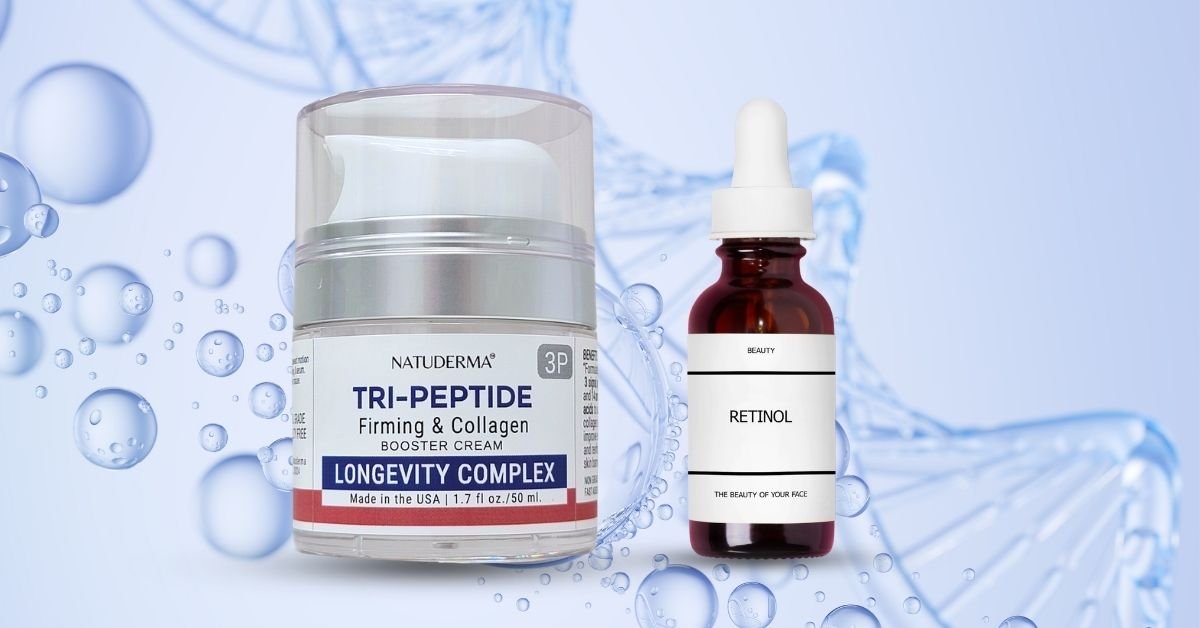
We specifically formulated the Natuderma Tripeptide Firming & Collagen Booster Cream with this layering approach in mind — its peptide triad, Hydrolyzed Collagen, amino acid matrix, and botanical antioxidant complex make it an effective finishing step whether you use it alone or over an active serum like retinol.
Start your peptide routine — or add the missing layer to your retinol protocol. The Natuderma Tripeptide Firming & Collagen Booster Cream works standalone or as the perfect complement to your retinol serum — delivering clinical peptide science, collagen support, and antioxidant defense in one daily formula.
→ Read next: How to Build a Professional Anti-Aging Routine at Home [Blog Post #4 — Coming Soon]